POCUS Research
Browse our growing literature library of POCUS related research. Each study links to original study.


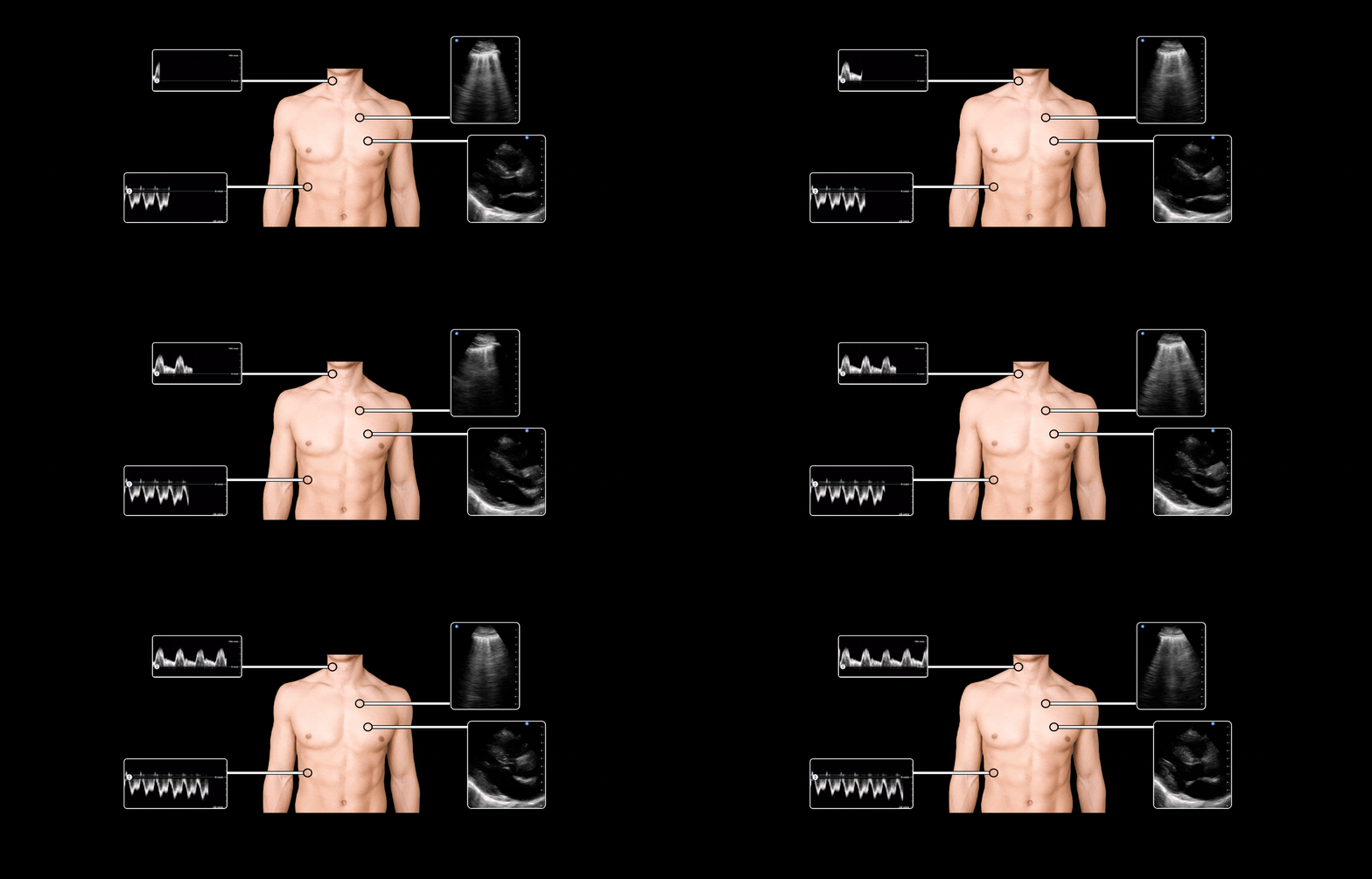

Learn POCUS and visually inspect the internal organs
Point-of-care ultrasound (POCUS) is a remarkably powerful tool that augments your physical exam by looking directly inside your patient and examining their internal organs in real-time, instead of just listening. It is exponentially more powerful than a stethoscope and provides highly reliable, real-time information at the bedside to help you diagnose and rule out myocardial infarctions, pulmonary edema, pneumonia, pulmonary emolus, deep vein thrombosis (DVT) and more.


Crystal Clear Point-of-Care Ultrasound Tutorials
POCUS Med Ed was founded by Dr. Larry Istrail, an assistant professor of internal medicine at the University of Virginia. He is the author of multiple POCUS books and research articles. Through POCUS Med Ed or The POCUS Textbook, you can access beautifully designed and ultra-simplified POCUS tutorials, optimized for busy clinicians. Learn how to evaluate patients with chest pain, shortness of breath, and more.
.png)
POCUS education with a focus on clarity
Point-of-care ultrasound (POCUS) frequently asked questions
What is POCUS?
Point-of-care Ultrasound (POCUS) is a method of examining a patient using ultrasound, where the clinician performs and interprets the ultrasound exam themselves at the bedside in real-time. In its most basic sense, it is simply the visual inspection of the internal organs. In a patient with chest pain, in addition to examining or palpating the chest, you can use POCUS to look inside the chest at the heart, lungs, skin, or soft tissues and make a diagnosis based on direct visualization rather than indirect, nonspecific biomarkers or sounds.
How is it different than sending a patient to radiology for an ultrasound?
With POCUS, you are the sonographer and the radiologist. You acquire the images and interpret them as part of your physical examination. This allows you to combine data from multiple organ systems to arrive at a diagnosis. This does not necessarily replace a sonographer or radiologist. Usually, the studies they perform take longer and are much more detailed than what a clinician would do during their physical exam.
Do you need a special ultrasound machine?
There are now many portable ultrasound probes on the market that fit into your white coat pocket and connect to a smartphone. These are ideal for POCUS; however, many hospitals also have cart-based ultrasound machines, which also can be used by the clinician for POCUS.
Does this replace the stethoscope?
Replacing the stethoscope is the wrong way to frame it. POCUS is a separate tool that provides higher-resolution, higher-accuracy visual data than the audible data a stethoscope provides. For most cardiopulmonary diseases, POCUS is superior to a stethoscope. The data on this is crystal clear. However, for certain diseases, like asthma or COPD, which do not affect the pleura, stethoscopes often still have a role. POCUS also requires significant experience, added cost, and extra training, which many did not have in medical school. So, did the TV replace the radio? Well, in most situations, yes. But when in the car, or on a run, radio or a podcast is superior to watching TV. This analogy is similar to the stethoscope versus POCUS debate.
What can you accurately diagnose with POCUS?
In general, POCUS can accurately diagnose or rule out many cardiopulmonary disease that can be diagnosed with imaging (as opposed to a blood test). Pulmonary edema, pulmonary fibrosis, pulmonary embolism, pleural effusions, and pneumonia are some examples of pulmonary diseases that POCUS can diagnose with high accuracy. POCUS is also highly accurate when evaluating patients for heart failure, valvular disease, pericardial effusions, or focal wall motion abnormalities from a myocardial infarction.
What are the limitations of POCUS?
POCUS is limited by the physics of ultrasound waves. Ultrasound cannot pass well through air-filled structures, so it cannot see inside the lung unless there is fluid or consolidated lung tissue present. This led to the belief that ultrasound cannot diagnose pulmonary disease, though this turned out to be completely wrong. The ultrasound can visualize the pleura and diagnose most pulmonary diseases as a result. It also cannot see through bone. Although it has high accuracy in visualizing the bone cortex and diagnosing many kinds of fractures, it cannot see inside or behind bones.
Isn't POCUS "operator dependent" and therefore not reliable?
Yes and no. It is absolutely true that learning POCUS takes significant time and experience before a clinician can use it reliably. However, it is also important to ask: "Compared to what?"
A stethoscope is also "operator dependent," though there are no quality assessment mechanisms or concerns regarding what a clinician may think they hear. When compared to standard imaging, something like a CT scan is considered not"operator dependent." But not all radiologists reading the same study come to the same conclusions. Radiologists have low agreement when diagnosing a subsegmental pulmonary embolus, for example.
Who runs POCUS Med Ed?
POCUS Med Ed was founded by Dr. Larry Istrail, an internal medicine physician and POCUS educator based in the United States. Dr. Istrail is the author of The POCUS Manifesto (2021) and The POCUS Textbook (2025) — two of the most accessible and widely referenced resources in point-of-care ultrasound education. His goal with POCUS Med Ed is to make high-quality POCUS education freely available to any clinician, anywhere in the world.

.png)
Books for kids, with a POCUS twist
Drs. Salami & Bean are POCUS-wielding physicians that use their quick wit, excellent bedside manner, and ultrasound vision to solve the medical mysteries of the animal kingdom. Get a copy of our children's POCUS and get your kids interested in medicine and POCUS early!
Why is POCUS important?
In Dr. Istrail's first book, he covers the history of point-of-care ultrasound (POCUS), what it is, how it came to be, and the evidence supporting it. It includes a fast-paced, narrative style with interviews of POCUS pioneers and seminal studies that have solidified POCUS as the future of bedside medicine for physicians, PAs and nurse practitioners who want to become a better clinician.
